


The benefit of a breast biopsy is that the patient should receive a definitive diagnosis of whether she (or he) has breast cancer or whether the breast abnormality in question is benign (non-cancerous). Once armed with this information, she can either breath a sigh of relief that she does not have cancer and continue to closely monitor her breasts with self-exams, physician performed clinical breast exams, and screening mammography at regular intervals. Or, if the biopsy reveals cancer, she can begin to consider treatment options.
Even if the biopsy shows benign (non-cancerous) results, the type of "benign" breast tissue on the final biopsy report can be helpful since some biopsy results may indicate an above average risk of developing breast cancer within one’s lifetime (such as atypical hyperplasia or lobular carcinoma in situ). In these cases, patients may begin taking preventive measures, such as making adjustments in cancer screening schedules or possibly beginning prophylactic therapy (for example, taking the drug tamoxifen).
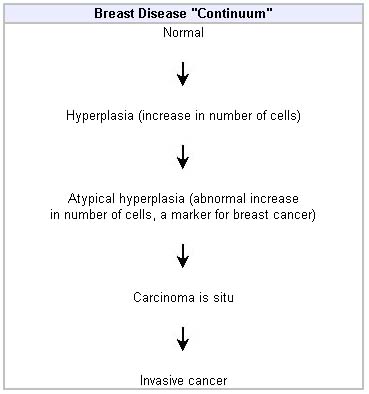
If biopsy results indicate the presence of a malignancy (cancer), the patient can begin to explore her treatment options. Typically, the early breast cancer is diagnosed, the greater the chances for survival. While it is important not to delay action, a patient should have a sufficient amount time to discuss her treatment options with her physician and family and make an informed decision on how best to proceed with treating the disease. A period of a few weeks or even a month is not unusual in preparing for definitive surgery (such as lumpectomy or mastectomy) and planning subsequent therapy (such as chemotherapy or radiation).
Though biopsy usually provides a correct and definitive diagnosis of breast cancer, biopsy can be a stressful (and sometimes painful) procedure for the patient. It is estimated that 65% to 80% of breast biopsies result in benign (non-cancerous) findings. Thus, women who are referred for breast biopsy are encouraged to consider an expert second opinion before undergoing the procedure. Patients are strongly encouraged to have a breast-imaging specialist review their mammogram films and other data before proceeding with the biopsy. In fact, many insurance plans encourage obtaining a second opinion prior to proceeding with surgery.
The risks of breast biopsy vary depending on the method of biopsy performed. The degree of risk will increase as the procedure becomes more invasive. Fine needle aspiration (FNA), core needle, and vacuum-assisted biopsies are minimally invasive and are typically very safe procedures. The benefits of these percutaneous (through the skin) biopsies often far outweigh the risks. However, as with all invasive procedures, certain risks do exist.
|
The Risk of Biopsy Increases As The Method Becomes More Invasive | |
| Type
of Biopsy
Surgical/Large Core Biopsy Vacuum-Assisted Biopsy Core Needle Biopsy Fine Needle Aspiration (FNA) Biopsy |
More Risk/More Invasive
|

