


- What is Large Core Biopsy?
- How Should Patients Prepare for Large Core Biopsy?
- How is Large Core Biopsy Performed?
Large core breast biopsy (also called ABBI, which is a brand name that stands for Advanced Breast Biopsy Instrumentation) is a surgical technique that involves removing an entire intact breast lesion (abnormality) under image guidance. While the ABBI procedure tends to be less invasive than the traditional open surgical biopsy, this technique has not gained widespread acceptance.
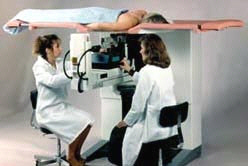 Large core biopsy requires the use of a prone biopsy table (the patient lies
face down) and stereotactic mammography imaging
equipment. Stereotactic mammography uses computers to pinpoint the exact
location of a breast mass based on mammograms (x-rays) taken from two different angles.
The computer coordinates will help the physician to guide the large core sampling device
to the correct area of the breast.
Large core biopsy requires the use of a prone biopsy table (the patient lies
face down) and stereotactic mammography imaging
equipment. Stereotactic mammography uses computers to pinpoint the exact
location of a breast mass based on mammograms (x-rays) taken from two different angles.
The computer coordinates will help the physician to guide the large core sampling device
to the correct area of the breast.
Large core biopsy (ABBI) can remove 5 millimeters (mm) to 20 mm of breast tissue. The procedure also allows the radiologist or surgeon to remove the entire lesion in one non-fragmented piece. However, some medical professionals question the benefit of this.
As with any surgical procedure, patients are typically given detailed instructions by their physician and anesthesiologist in advance of the day of their biopsy. Often, patients will be told to avoid aspirin, ibuprofen, or other medications that prolong bleeding for five to seven days prior to the biopsy. Patients should also ask their physicians if they should discontinue using blood thinners prior to the biopsy.
On the day of the large core biopsy, women should wear a comfortable two piece garment. Patients should not wear talcum powder, deodorant, lotion, or perfume under their arms or on their breasts on the day of the biopsy.
As with any biopsy procedure, the breast is first cleaned. During the large core biopsy (ABBI) procedure, local anesthetic is injected while the breast is maintained in compression. A wire is then guided into the breast lesion using stereotactic mammography. Next, a narrow tube with a cutting device (a cannula, also called the large core needle) is inserted into the breast, using the wire as a guide. The core specimen of the breast tissue is then removed with a looped wire and taken to the pathology laboratory for diagnosis.
The lesion removed with large core biopsy (ABBI) is contained within a protective cylinder shell so that the surrounding normal breast tissue is not exposed to the operative site. Additional mammograms of the breast and the removed specimen are performed after the procedure to confirm the biopsy. Due to the size of the large biopsy section, stitches are usually required. Large core biopsy (ABBI) takes approximately one hour, often followed by several hours of recovery.
Large core biopsy (ABBI) requires stitches and a long recovery than percutaneous ("through the skin") breast biopsy procedures (such as fine needle aspiration (FNA), core needle biopsy, or vacuum-assisted biopsy). Patients may be instructed to take Tylenol or other pain relievers for discomfort if needed. Some bruising of the breast area may occur during the first five to seven days after large core biopsy (or longer if initial bleeding during biopsy was greater than usual). Temporary bruising of the breast is normal and is usually not a medical concern.
Patients should contact their physicians if they experience any excessive swelling, bleeding, drainage, redness, or heat in the area of the biopsy or breast. Patients should discuss the final results of the biopsy procedure with their referring physician within a few days of the procedure.
Some interventional breast radiologists feel strongly that the large core biopsy (ABBI) procedure is not an appropriate method of breast biopsy. Unlike open surgical biopsy, in which the surgeon only removes a narrow strand of breast tissue in order to reach the lesion, large core biopsy (ABBI) requires the removal of a significant portion of normal breast tissue just to reach the lesion. Critics of large core biopsy (ABBI) say that the procedure removes unnecessary normal breast tissue and does not remove an adequate margin of tissue around the breast lesion for laboratory analysis. For these reasons, large core biopsy (ABBI) is not widely embraced in the medical community. Vacuum-assisted biopsy may be a viable alternative to large core biopsy (ABBI) in some instances.
