


Ductal lavage is a diagnostic procedure being developed by breast surgeon Susan Love, MD and researchers at the company, Pro-Duct Health, to be used in addition to clinical breast exams and mammography. Ductal lavage helps identify cancerous and pre-cancerous cells by examining samples of cells from the milk ducts of the breast. Dubbed the "breast pap smear," Dr. Love believes ductal lavage can help physicians better understand how breast cancer develops and identify women most likely to develop breast cancer. However, the test is only recommended for women at high risk of breast cancer (as determined by family history, etc.).
Physicians estimate that over 95% of breast cancers begin in the cells lining the breast ducts. It can take up to eight to 10 years before these cells grow into a tumor large enough to be detected by mammography (approximately one centimeter in diameter) or felt during a physical breast exam. The term "lavage" is French and means "wash" or "rinse." Ductal lavage involves analyzing cells washed out from the breast ducts to determine whether they have malignant qualities before they develop into breast cancer.
Ductal lavage is a minimally invasive procedure that involves collecting samples of breast ducts cells and then examining the cells under a microscope to determine whether they are normal, atypical, suspicious, or malignant. The idea of testing fluid from the nipple was first suggested in the 1950s by Dr. Papanicolaou, the physician who developed the Pap smear to test for cervical cancer.
Most women who undergo ductal lavage experience little to no discomfort during the procedure. To perform ductal lavage, the physician will apply a small amount of anesthetic cream to the nipple area. A breast pump (or aspirator) is then used to apply mild suction to the nipple to draw out tiny amounts of nipple fluid from the milk ducts up to the nipple surface. Typically, fluid will only be extracted from one or two breast ducts (each breast contains six to eight ducts). These ducts, according to Dr. Love, are most likely to contain abnormal cells. Once these ducts have been identified, an anesthetic is infused into the duct and a catheter is threaded into the duct opening in the nipple for a small distance. Next, salt water is sent through the catheter into the breast duct to "wash" the duct and collect cells. The breast cells that are washed out are sent to the pathology laboratory for analysis.
| Step 1 | |
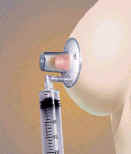 |
Mild suction helps draw out tiny amounts of nipple fluid. This allows the physician to determine which ducts to lavage, and pinpoints openings on the nipple surface. |
| Step 2 | |
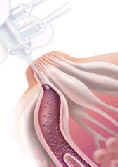 |
A catheter is inserted into the duct opening, and saline is used to "wash" the duct and collect cells. |
| Step 3 | |
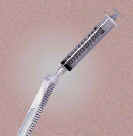 |
The cells are then sent to the pathology laboratory for microscopic examination. |
|
*Images courtesy of Pro-Duct Health. | |
The goal of ductal lavage is to determine whether breast ducts cells have certain abnormal characteristics which may cause them to develop into cancer at a later date. If pre-cancerous cells exist, women may wish to consider preventive measures to help protect against breast cancer. Since ductal lavage can be repeated, physicians can track changes in a woman’s cells over time.
Preventive measures may include:
- Close monitoring with mammography, clinical breast exams, and breast self-exams
- Taking the drug tamoxifen, an anti-estrogen
- Considering prophylactic mastectomy (preventive breast removal) for women at very high risk of breast cancer
Researchers are also investigating whether ductal lavage may detect breast cancer at a very early stage, even before it can be seen with mammography (and often years before a breast lump can be felt). The earlier breast cancer is detected, the more likely treatment will be successful. According to Dr. Love, ductal cells could also be used by scientists to study breast cancer genes and environmental factors that affect breast cells.
Some clinical data have shown that ductal lavage may be beneficial at helping to detect breast cancer in women at high risk for the disease. At 23rd annual San Antonio Breast Cancer Symposium in December 2000, William Dooley, MD of the Johns Hopkins Breast Center, shared results of his study. Over 500 women at high risk of breast cancer (as determined by family history, etc.) underwent ductal lavage. The women also had screening mammograms and physician-performed clinical breast exams. Of 383 eligible women, ductal lavage detected:
- Atypical cells in 17% of the women (66/383)
- Suspicious/malignant cells in 7% of the women (26/383)
However, the presence of atypical breast cells does not necessarily mean a women will develop breast cancer, and in fact, most atypical cells do not progress to cancer. Therefore, physicians suggest that ductal lavage only be performed on women who have already been determined to be at risk for breast cancer.
Women at high risk of breast cancer include:
- Those with a strong family or personal history of breast cancer
- Those who test positive for BRCA1 or BRCA2 gene mutations
- Those with a history of breast biopsies showing non-cancerous conditions (such as lobular carcinoma in situ or atypical hyperplasia)
More recently, a study appearing in the October 2004 issue of the Journal of the National Cancer Institute found that ductal lavage was ineffective at detecting breast cancer among women who had already been diagnosed with the disease. In the study, Seema A. Khan, MD, of the Lynn Sage Comprehensive Breast Center in Chicago, and colleague performed ductal lavage on 32 women who had been diagnosed with breast cancer, prior to mastectomy. They also performed ductal lavage on seven high-risk women before having preventive mastectomies. They found that ductal lavage detected atypical or cancerous breast cells in only five of the 38 cases. Further research is needed to determine the effectiveness of ductal lavage.
Currently, ductal lavage is available at a handful of locations across the United States. Ductal lavage is expected to become available at more locations in the future, as more physicians complete the required special training. Click here for a list of physicians who perform ductal lavage. Please note, in most cases, women must meet eligibility requirements to have ductal lavage performed.
- Pro-Duct Health, a company co-founded by Susan Love, MD, provides information on ductal lavage, including a list of locations that perform the procedure, at http://www.producthealth.com/
- Those interested in learning more about ductal lavage may call Pro-Duct health at 1-866-446-DUCT (for patients) or 1-866-4-LAVAGE (for medical professionals).
- The October 4, 2000 Imaginis.com report, "Testing Nipple Fluid May Help Determine Women at High Breast Cancer Risk," is available at http://www.imaginis.com/breasthealth/news/news10.04.00b.asp
- The February 24, 2000 Imaginis.com report, "New Breast Cancer Detection Method Involves Testing Nipple Fluid," is available at http://www.imaginis.com/breasthealth/news/news2.24.00.asp
- Susan Love, MD provides information on ductal lavage on her website at http://www.susanlovemd.com/lavage_frames.html
- Dr. Susan Love's Breast Book (1995) by Susan M. Love, MD and Karen Lindsey contains substantial information about all aspects of breast cancer, including risk factors, symptoms, diagnosis, treatment, and survival. Click here for pricing and ordering information.
Updated: December 17, 2007
