


- What Should a Woman Do If She Finds a Breast Lump?
- What Signs Suggest a Lump is Likely to Be Cancerous?
- How Are Breast Lumps Evaluated By Physicians?
Notice: Revised breast cancer screening guidelines issued in November 2009.
The discovery of a breast lump, whether by chance, a breast self-exam, or during a clinical breast exam, can be stressful for a woman. Because a lump can be a symptom of breast cancer, all persistent breast lumps should be evaluated by a physician. However, the majority of breast lumps (approximately 80%) are due to non-cancerous causes.
While the American Cancer Society and other organizations no longer recommend that woman perform monthly breast self exams, these organizations suggest that self exams can be performed to help detect changes in the breasts to call to a physician's attention. Women who perform self exams should consult a healthcare professional to determine how to correctly perform the exam. If women learn to perform BSE correctly, they can help detect changes and bring them promptly to a medical professional. These self-exams allow women to become familiar with how their breasts look and feel so they can more readily detect any changes that may occur. Many women naturally have some lumpiness and asymmetry (differences between the right and left breast). Breast self exams can help women find changes in the breast(s) that persist over time. If a new lump is found and does not disappear after the menstrual cycle, then it should be reported to a physician for clinical evaluation.
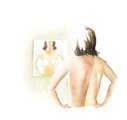
All persistent breast lumps should be evaluated by a physician. Practicing monthly breast self-exams helps women get to know their breasts and more easily detect changes.
Learn more about breast self-exam.
It is not possible for a woman or a physician to know for certain whether a breast lump indicates breast cancer until imaging exams (such as mammography and ultrasound) and/or biopsy are performed. A breast biopsy involves taking a sample of breast tissue and examining it under a microscope to determine whether it contains cancer cells. However, there are certain characteristics associated with lumps that can suggest whether they are more likely to be cancer or benign (non-cancerous).
Signs that suggest a lump is more likely to be cancerous:
- The lump is firm and hard
- The lump is not discrete; it is not easily distinguishable
- The lump is fixed in the breast; it does not move
- There is only one lump
- There is not an identical lump in the opposite breast
- The skin of breast is dimpled
- The lump is accompanied by bloody nipple discharge
Signs that suggest a lump is less likely to be cancerous:
- The lump is soft
- The lump is discrete; it is easily distinguishable
- The lump moves in the breast
- There are multiple breast lumps
- There is an identical lump in the opposite breast
- The lump disappears after the menstrual cycle
While the above signs can help suggest whether a lump is more likely or less likely to be cancerous, having one or more of these characteristics does not guarantee or eliminate the possibility of having breast cancer. These characteristics merely provide clues for the physician when evaluating a lump. Some breast cancers can have characteristics found in the "less likely to be cancerous" category. Therefore, all persistent breast lumps need to be presented to a physician.
Fibrocystic breasts: Fibrocystic breast condition is a common, non-cancerous condition that affects more than 50% of women at some point in their lives. In fact, the condition is so common that many physicians refrain from using the term "fibrocystic" and simply tell their patients that their breasts are lumpier than average but are still normal.
The most common signs of fibrocystic breasts include: lumpiness, tenderness, cysts, areas of thickening, fibrosis, and breast pain. Having fibrocystic breasts, in and of itself, is not a risk factor for breast cancer. However, fibrocystic breast condition can sometimes make it more difficult to detect a hidden breast cancer with standard examination and imaging techniques. Therefore, it is important that women with fibrocystic breasts practice monthly breast self-exams, receive regular clinical breast exams, and have yearly screening mammograms (the latter beginning at age 40).
Symptoms of Fibrocystic Breasts
- cysts (fluid-filled sacs)
- fibrosis (scar-like connective tissue)
- lumpiness
- areas of thickening
- tenderness
- pain
The degree to which women experience symptoms of fibrocystic breast condition varies considerably. Some women with fibrocystic breasts have only mild breast pain and may not be able to feel any breast lumps when performing breast self-exams. Other women with fibrocystic breasts may experience more severe breast pain or tenderness and may feel multiple lumps in their breasts. Most fibrocystic breast lumps are found in the upper, outer quadrant of the breasts (near the armpit), although these lumps can occur anywhere in the breasts. Fibrocystic breast lumps tend to be smooth, rounded, and mobile (not attached to other breast tissue), though some fibrocystic tissue may have a thickened, irregular feel. The lumps or irregularities associated with fibrocystic breasts are often tender to touch and may increase or decrease in size during the menstrual cycle.
