


- Q: Do all women have enough breast tissue to have a mammogram?
- Q: Will portions of breast tissue not be imaged on women with small breasts because the tissue does not protrude very much?
- Q: Is mammography less accurate on women with small breasts?
- Q: Is a mammogram more painful for women with small breasts?
- Q: Are small-breasted women less likely to get breast cancer because they have less breast tissue?
- Q: What are some alternative breast cancer screening exams for women with small breasts?
- Additional Resources and References
Many women, particularly those with small breasts, are worried that a mammogram will be painful and may not accurately detect breast cancer. While mammography does involve breast compression, which may be temporarily uncomfortable for some women, the procedure should not be significantly painful for any patient. No two mammogram patients have identical breasts, and therefore, each patient provides a unique set of challenges for the mammogram technologist. However, a good technologist is skilled at imaging all breast sizes and shapes, from large, pendulous breasts to small, dense ones.
The following are common questions about mammography on small breasts:
A: A good mammography technologist should be able to image all breast sizes and shapes, including very small breasts. Women with small breasts should have enough breast tissue for a mammogram. In fact, most men have just enough breast tissue to cover the first photocell of a mammography machine. If there is not enough breast tissue, the technologist may have to time the mammogram manually, though it is still possible to obtain an image. Men are often referred for mammograms if a breast abnormality is detected by their physician.
Q: Will portions of breast tissue not be imaged on women with small breasts because the tissue does not protrude very much?
A: There is always a small amount of breast tissue that cannot be imaged with mammography regardless of breast size: the area between the edge of the film cassette and the chest wall. This area is typically the same in all patients, regardless of breast size.
A: Mammography is approximately 85% to 90% accurate in detecting breast cancers in women, regardless of breast size. Mammography is not typically less accurate at revealing breast cancer in women with smaller breasts; however, it may be more difficult to detect cancer in dense breasts as opposed to breasts made up of more fat content. In general, smaller-breasted women tend to have dense breasts and larger-breasted women tend to have more fat in their breasts. Fat appears as a black area on a mammogram film, making it fairly easy to detect any abnormalities while dense breast tissue appears as a white area, sometimes obscuring abnormalities (which also appear as white areas). For these reasons, breast self-exams and physician performed clinical breast exams should also be performed to help detect breast cancer in its earliest stages. The majority of cancers are found in the upper, outer quadrant of the breast, which is approximately the same size in most women. The mediolateral oblique (MLO) mammography view helps image this portion of the breast.
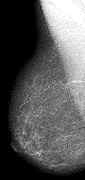
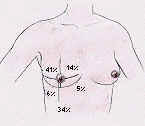
41% of breast cancers are found in the upper, outer quadrant of the breast and 34% are found in the area behind the nipple. Image courtesy of the American Medical Association
