


Monthly breast self-examination (BSE) includes both looking and feeling over the entire breast and chest area. Women should use the pads, not the tips, of the three middle fingers when performing BSE. The time required to perform the exam varies with the size and features of a woman's breasts but usually only takes about 15 to 20 minutes each month. Women should be sure to examine the breasts in the same manner each month, check the entire breast and armpit area, and remember how the breasts feel from month to month. Some women prefer to keep a small diary of their monthly breast self-exams.
Breast self-examination (BSE) is best performed lying down.
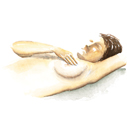 Lie down with a pillow or folded towel under the right shoulder and place the right arm behind the head. Check
the entire breast and armpit area using the pads of the first three middle fingers on the left hand to feel
for lumps, changes, or irregularities in the right breast. Apply 3 pressures-light, medium, and deep-in dime-sized
circles to feel the entire thickness of the breast." A firm ridge in the lower curve of each breast is normal. The
exam should then be repeated on the left breast, using the finger pads of the right hand (the pillow or folded
towel should also be moved under the left shoulder at this time).
Lie down with a pillow or folded towel under the right shoulder and place the right arm behind the head. Check
the entire breast and armpit area using the pads of the first three middle fingers on the left hand to feel
for lumps, changes, or irregularities in the right breast. Apply 3 pressures-light, medium, and deep-in dime-sized
circles to feel the entire thickness of the breast." A firm ridge in the lower curve of each breast is normal. The
exam should then be repeated on the left breast, using the finger pads of the right hand (the pillow or folded
towel should also be moved under the left shoulder at this time).
It is important to thoroughly examine the entire area of the breast every month:
- Outside: armpit to collar bone, and below the breast
- Middle: the breast itself
- Inside: the nipple area
|
|
However, cancerous tumors are more likely to be found in some parts of the breast than in others. Approximately half of all breast cancers occur in the upper, outer region of the breast toward the armpit. Some physicians refer to this upper outer region as the "tail" of the breast and encourage women to examine it with great care.
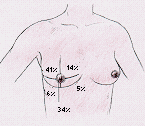 |
Approximate percentage of breast cancers found in each area:
|
Image courtesy of the AMA
Women should notify their physicians of any changes in their breasts.
 Click here
for general information on breast self-exam (BSE).
Click here
for general information on breast self-exam (BSE).
Click
Here to View Breast Self-Examination Video 
Updated: November 28, 2009
