


- Overview
- Types of Breast Reconstruction
- Past Controversy over Silicone-Filled Breast Implants
- Finding a Plastic Surgeon
- Possible Complications With Breast Reconstruction
- Advantages and Disadvantages to Immediate Breast Reconstruction
- Breast Imaging After Reconstruction
- Additional Resources and References
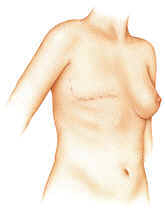 |
| Post-mastectomy
scar. Image Courtesy of Allergan, Inc. |
Breast reconstruction is a surgical procedure to rebuild the contour of the breast, along with the nipple and areola (the pigmented area surrounding the nipple) if desired. Recent advances in reconstructive techniques have given patients more choices when it comes to breast reconstruction, including the option to have breast reconstruction during the same operation in which the breast is removed. While a breast cancer diagnosis requires timely treatment decisions, most women have a sufficient amount of time to research treatment and reconstructive options before breast cancer surgery.
Though some women are not interested in breast reconstruction, many breast specialists support reconstructive surgery as an important option for patients to consider. Women are encouraged to weigh both the advantages and disadvantages of breast reconstruction with their plastic surgeons and cancer treatment team and make an informed decision based on their own situation. Breast reconstruction is most often an option for women who have had mastectomy if their entire breast has been removed. Women who undergo lumpectomy (surgical removal of a breast lump and a margin of surrounding tissue) rarely need breast reconstruction.
The goal of breast reconstruction is to create breast symmetry when a woman is wearing a bra. When a woman is nude, the reconstructed breast will look different from the unaffected breast, regardless of the type of reconstruction chosen. However, when a woman is wearing a bra, the size and shape of the reconstructed breast should closely resemble the unaffected breast.
It is a common misconception that women may have to wait a year or longer to begin the reconstructive progress after breast surgery. Though breast cancer patients who receive chemotherapy after mastectomy may have to delay reconstruction under chemotherapy is finished, the majority of women begin may reconstruction soon after the surgery in which the breast is removed (if not during the same operation).
There are two main types of breast reconstruction available to most mastectomy patients:
- Breast implants
- Muscle flap reconstruction
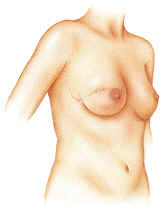 |
| Breast reconstruction
with implant. Image courtesy of Allergan, Inc. |
The insertion of breast implants is usually a two-part procedure. The first implant operation involves placing a tissue expander in the intended breast area beneath the skin and chest muscle. The tissue expander is similar to a balloon, and the surgeon will fill the expander with salt-water solution periodically (usually once a week). The procedure to insert the tissue expander into the breast area typically takes about forty-five minutes. After the skin has sufficiently stretched, the surgeon will replace the tissue expander with a permanent implant, usually three to four months after the first implant surgery. Occasionally, a woman will not need a tissue expander. If this is the case, then the surgeon will proceed directly to permanent implant surgery. Approximately 50% of implants need some type of modification or replacement after five or ten years.
Muscle flap procedures take much longer than implant operations, lasting about four to five hours, and patients typically stay in the hospital three to four days, compared to one day with the implant operation. Though the recovery is slower, the breast usually looks and feels more natural to most women.
Because muscle flap reconstruction involves the blood vessels, women who smoke or have diabetes, vascular, or connective tissue diseases cannot typically undergo this type of breast reconstruction.
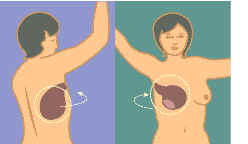 |
Latissimus dorsi muscle flap (back tissue) reconstruction. Image courtesy of NIH/NCI. |
Because many breast cancers involve the nipple areolar complex, the surgeon usually removes the nipple during mastectomy. After the breast volume has been rebuilt with a tissue expander or muscle flap procedure, the nipple may be recreated. Most nipple recreation takes place two to six months after the initial breast reconstruction to allow the new breast area ample time to heal. A new nipple may be created from a skin graft from a woman’s inner thigh or from the areola (the pigmented region surrounding the nipple) on her natural breast. Occasionally after a skin graft, the skin of the newly created nipple turns white. Some surgeons prefer to tattoo the skin graft of the new nipple to ensure that the color matches the color of the nipple from the natural breast.
To learn about advances in breast reconstruction, please visit http://www.imaginis.com/breasthealth/advances_breast_reconstruction.asp
