


If a person has a sign or symptom that might indicate cancer, his or her doctor will do a physical exam and ask about his or her medical history. In addition, the doctor usually orders various tests and exams.
Diagnostic cancer examinations may include:
|
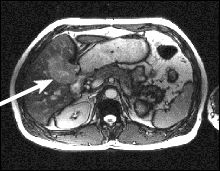
| Rapid acquisition MR image (axial plane) shows a tumor in the liver (arrow) |
- Imaging produces detailed pictures of the inside of the body. In many cases imaging can clearly show the presence, size, shape and location of tumors, and if cancer has spread (metastasized) to other body parts. For additional information see The Role of Medical Imaging in the Prevention, Diagnosis and Treatment of Cancer .
- Endoscopy allows the doctor to look directly inside certain organs (using a special, thin fiber optic cable called an endoscope for viewing inside the body). For example, colonoscopy uses an endoscope to look inside the colon. During an endoscopy examination, the doctor may collect tissue or cells for closer examination with lab testing.
- Biopsy involves sampling of organ tissue (for lab testing) that is suspected of being cancerous. Biopsy may involve removing the entire mass (tumor) for testing. Biopsy is often done using the guidance of imaging or endoscopy. If cancer is present, a pathologist can usually tell what type of cancer it is and may be able to judge whether the cells are likely to grow slowly or quickly.
- Laboratory tests check blood, urine, fecal and/or tissue samples for presence of cancer. If cancer is present, lab work may show the effects of the disease on the body. In some cases, special tests are used to measure the amount of certain substances in the blood, urine, other body fluids or tumor tissue. The levels of these substances may become abnormal when certain kinds of cancer are present. In the case of biopsy, a pathologist will examine the tissue under a microscope or with other means to check for cancer cells.
|
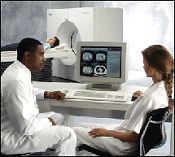
| The doctor and technologist discuss the patient's chest and abdomen CT examination |
- Staging, is a method to help the doctor determine the stage, or extent, of the disease so the best course of treatment can be planned. The doctor may order various tests and exams to determine whether the cancer has spread and what parts of the body have been affected. In some cases, lymph nodes near the tumor are removed and checked for cancer cells. If cancer is found in the lymph nodes, it means cancer may have spread to other organs.
-
Updated: June 9, 2008
