 |
Most CT examinations are similar
and include the following steps:
- Patients are encouraged to bring
something to read or do in case there are any delays prior to their CT exam. Patients
should wear comfortable, loose fitting clothing for their CT exam. Patient preparation for
a CT examination involves removing any articles of clothing or jewelry that might degrade
the CT images, such as belts, earrings, bras, glasses, dentures, hairpins, etc. Zippers
and snaps common in many clothes can also cause image degradation. In some cases, the
patient may be asked to wear a patient gown (such as CT imaging of the body). Many CT
examinations require the oral or intravenous administration of a contrast
agent, a liquid material that enhances the images of the organs and/or blood vessels.
- The patient is positioned by the
technologist on the specialized CT table. The area of interest, for example the chest, is
positioned inside the CT gantry opening, usually with the help of cross-hair type
positioning lights. Some types of CT examination, for example a "coronal CT of the sinuses" may
require the patient to be positioned in a special head holder that extends the head and
neck. For such precise CT examinations, soft straps may be used to help position and
immobilize the patient's head.
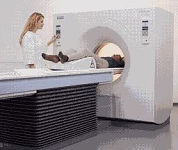
| The technologist positions a
patient for a CT of the abdomen |
 |
- Once the patient is comfortably and
correctly positioned, the technologist leaves the CT patient room. For many types of CT,
for example CT of the chest or abdomen, the patient is asked to hold their breath and
remain perfectly still for a few moments up to about 30 seconds while the technologist
acquires the CT data set. During the CT examination, the technologist and patient can
communicate at any time using an intercom. The CT technologist controls the CT examination
from a workstation console in the control room next to the room with the CT scanner. The
technologist watches the patient during the study and monitors the progress of the image
acquisition during the study.
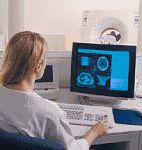
 |
The technologist monitors the
patient through the window as they talk to one another over the intercom |
- Patients should lie still and relax
during a CT study. Patients may hear the CT scanner rotating during the study. Depending
upon the type of study being performed and the model of CT scanner being used, the
whirring noise may be very quite or more noticeable. The table will move very slowly
during the CT data acquisition. Depending upon the type of study being performed, the
table will either move in several small increment of a few millimeters (for example for a
CT of the brain), or the table will move in one large continous step, for example 20 or 30
cm for a CT of the lungs. The gantry of the CT scanner may tilt in either direction during
CT exams such as head, sinus, inner ear and spine imaging. This allows the CT images to be
angled to better image anatomy such as spinal disks.
| Time lapse photo showing table feed
of patient through the CT scanner aperture |
 |
- Some CT studies will require the
technologist to come into the patient room in the middle of the exam to administer the contrast media via injection.
- Once the CT examination is complete, the
technologist will ask the patient to get dressed and wait while the CT images are
reviewed, either on film or monitor.
- After the CT images are reviewed, the
patient will be released from the imaging department or center. In some cases, more CT
images will need to be taken or a different study such as magnetic resonance imaging or
ultrasound will need to be performed. For additional information see "what happens during a diagnostic imaging examination?"
Updated: September 13, 2007
|
This Article Can Be Found At:
Copyright © 1997-2008 Imaginis Corporation.
All rights reserved. Imaginis® is a registered service mark of Imaginis Corporation, a health services
company. All other trademarks and copyrights are property of their respective owners.
Note: Use of this online service is subject to the disclaimer and the terms and conditions contained
herein. Information found within the Imaginis.com website or in other sites linked to from Imaginis.com
is provided for educational purposes only and is not intended to be used as a substitute for diagnosis
and treatment by a medical doctor. Imaginis does not endorse and has no responsibility for the content
of any other sites listed on Imaginis.com, and provides links and references merely as a convenience
to its users. Seek immediate medical attention if your condition is urgent.