


A spinal fracture (also called a vertebral compression fracture) occurs when one of the bones of the spinal column fractures. When more than one spinal fracture occurs, loss of height or spinal deformities such as a dowager's hump may result.
Certain conditions, including cancer, osteoporosis and long-term use of steroids or other drugs, can make your bones fragile and more likely to break.
For many, the pain caused by spinal fractures severely limits activity and reduces overall quality of life1,2,3,4. Over time, the pain may go away as the fracture heals in its deformed position, but for some, the fractured vertebra continues to break and the pain persists.
Women who have survived breast cancer may be at increased risk for spinal fractures1. Breast cancer treatment regimens can include blocking or eliminating sex hormones such as estrogen, that may promote the growth of cancer cells. In a healthy woman, these hormones play an important role in maintaining bone health, so when they are reduced or destroyed during cancer treatment, bone loss can occur. The bones of the spinal column are particularly sensitive to hormonal changes; this may explain why spinal fractures are common in breast cancer survivors.
Breast cancer can metastasize from the site of origin to bone, resulting in weak and unstable bone and an increased risk for fracture. Pain is usually the earliest sign that metastasis to the bone has occurred; however, metastasis can also occur without symptoms. Women with a history of breast cancer should take note of any new or unusual symptoms and notify their physician accordingly.
Finally, many types of chemotherapy can induce bone loss, leaving cancer patients more prone to fracture.
If spinal fractures are not treated properly, they can cause serious medical consequences2,3,4,5. KYPHON® Balloon kyphoplasty is a minimally invasive procedure that can repair spinal fractures. Orthopaedic balloons are designed to lift the fractured bone. Performed under local or general anesthesia, the procedure typically takes about one hour per fracture treated. It can be done on an inpatient or outpatient basis and may require an overnight stay depending on medical necessity.
|
Balloon Kyphoplasty | |
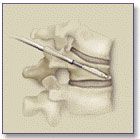 |
Step 1: Balloon Placement
With a hollow instrument, a narrow pathway is made into the fractured bone. A small orthopaedic balloon is guided through the instrument into the vertebral body. The incision site is approximately 1 cm (1/3 inch) in length. Typically, two balloons are used, one on each side of the vertebral body. |
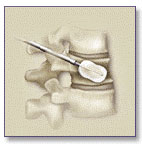 |
Step 2: Cavity Creation Next, the balloons are carefully inflated in an attempt to raise the fractured vertebral body. |
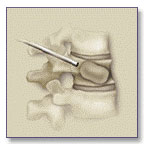 |
Step 3: Balloon Inflation Inflation of the balloons creates a cavity (space) within the vertebral body that compacts the soft, inner bone against the outer wall. The cavity also functions as a “container†for the bone cement. Once the vertebral body is in the final position, the balloons are deflated and removed. |
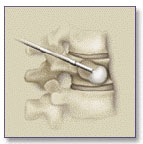 |
Step 4: Cavity Fill The cavity is filled with bone cement which is intended to stabilize the fracture. |
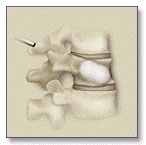 |
Step 5: Internal Cast The bone cement forms an internal cast. |
|
Images Courtesy of Medtronic | |
- 1Fourney, D.R. Percutaneous vertebroplasty and kyphoplasty for painful vertebral body fractures in cancer patients. J Neurosurg(Spine 1)
- 2Silverman, S.L., et al., The relationship of health-related quality of life to prevalent and incident vertebral fractures in postmenopausal women with osteoporosis: results from the Multiple Outcomes of Raloxifene Evaluation Study. Arthritis Rheum, 2001. 44(11): p. 2611-9.
- 3Silverman SL. The clinical consequences of vertebral compression fracture. Bone 1992;13 Suppl 2:S27-31.
- 4Gold DT, Silverman SL. The downward spiral of vertebral osteoporosis: consequences (Monograph). Cedars-Sinai Medical Center 2003.
- 5van Schoor NM, Smit JH, Twisk JW, Lips P. Impact of vertebral deformities, osteoarthritis, and other chronic diseases on quality of life: a population-based study. Osteoporos Int 2005;16(7):749-56.
- 6Garfin, S.R., R.A. Buckley, and J. Ledlie, Balloon kyphoplasty for symptomatic vertebral body compression fractures results in rapid, significant, and sustained improvements in back pain, function, and quality of life for elderly patients. Spine, 2006. 31(19): p. 2213-20.
- 7Ledlie, J.T. and M.B. Renfro, Kyphoplasty treatment of vertebral fractures: 2-year outcomes show sustained benefits. Spine, 2006. 31(1): p. 57-64.
- 8Phillips, F.M., et al., Early radiographic and clinical results of balloon kyphoplasty for the treatment of osteoporotic vertebral compression fractures. Spine, 2003. 28(19): p. 2260-5; discussion 2265-7.
- The National Osteoporosis Foundation provides information on bone pain, http://www.nof.org/
- The American Cancer Society provides information on bone pain in cancer patients, http://www.cancer.org/
- The National Institute of Arthritis and Musculoskeletal and Skin Diseases provides information on bone health, National Institute of Arthritis and Musculoskeletal and Skin Diseases http://www.niams.nih.gov/
- Medtronic is a leading company specializing in medical technology, including balloon kyphoplasty, http://www.medtronic.com/
- Click Here to View Balloon Kyphoplasty Video

Updated: August 2011
