


 |
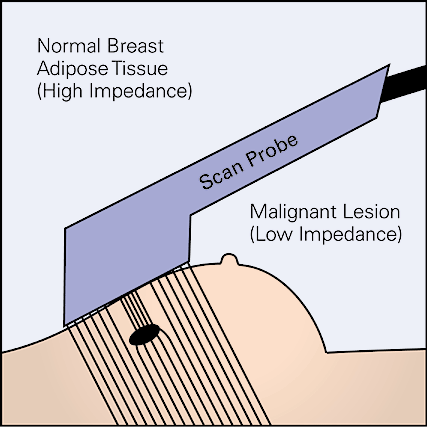
Sensors on the T-scan scanning probe placed against the skin of the breast measure low-level electrical currents transmitted through the body. The impedance of breast tissue under the scanning probe is measured and then displayed in real-time as images on a monitor. These images will show cancer (lower impedance) as bright, white spots on an otherwise gray background of normal or non-cancerous breast tissue (higher impedance).
Impedance is the measure of the degree to which an electric circuit resists electric-current flow when a voltage is impressed across its terminals. Impedance, expressed in Ohms, is the ratio of the voltage impressed across a pair of terminals to the current flow between those terminals. In direct-current (DC) circuits, impedance corresponds to resistance. In alternating current (AC) circuits, impedance is a function of resistance, inductance, and capacitance. Inductors and capacitors build up voltages that oppose the flow of current. This opposition, called reactance, must be combined with resistance to find the impedance. The reactance produced by inductance is proportional to the frequency of the alternating current, whereas the reactance produced by capacitance is inversely proportional to the frequency.
Neoplastic (cancerous) tissue causes alterations in intracellular and extracellular fluid compartments, cell membrane surface area, macromolecules, ionic permeability, and membrane associated water layers. These histological and biochemical changes within the cancerous tissue give rise to measurable changes in tissue electrical impedance. When a small alternating current is placed across the breast, the focal increase in electrical conductance and capacitance of the cancer tissue distorts the electric field within the breast. The resulting impedance map shows the cancer as a focal brightness on the gray scale image of conductivity and capacitance measured by an array of signal sensors on the skin surface.
Updated: January 27, 2000
