


- The Female Reproductive System
- Onset of Menstruation
- Length of Menstruation and the Menstrual Cycle
- The Menstrual Cycle
- Physical and Emotional Changes Associated with the Menstrual Cycle
- Menstrual Problems
- Resources for Information on Feminine Products
- Additional Resources and References
Menstruation, the periodic shedding of the uterine lining (the endometrium) accompanied by bleeding, is a natural process that occurs in pre-menopausal women who are not pregnant or breast-feeding. Menstruation marks the fertile years of a woman’s life when she is able to bear children. Menstrual cycles (menses) typically begin in girls two to three years after the onset of puberty (around age 12 or 13) and continue until menopause (around age 48 to 52).
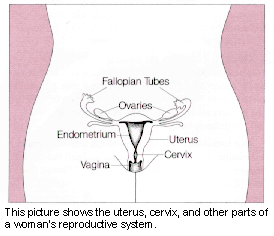
The female reproductive system is made up of both external and internal organs.
Vulva: The term vulva refers to the external parts of the female genitalia. The upper portion of the vulva is covered with pubic hair in mature females. The lower portion of the vulva consists of the labia majora (outer lips), which are two folds of fatty tissue covered with skin. Inside the labia majora are the labia minora (inner lips), another two folds of tissue. The labia minora protect the opening of the urethra (urine canal) and the entrance to the vagina. Above the urethra, the labia minora join to form the tip of the clitoris. The clitoris plays a key role in female sexual arousal.
Vagina: The vagina is the canal that leads from the uterus to the outside of the body. It serves as a passageway for menstrual discharge and as the birth canal. In young girls, the opening of the vagina is covered by a thin membrane called the hymen. As a woman begins to increase physical activity, use tampons, or engage in sexual intercourse, the hymen is gradually stretched.
Cervix: The cervix is the lower portion of the uterus that connects the uterus to the vagina. The opening of the cervix remains small except during labor when it expands to allow the baby to pass from the uterus to the vagina. Click here to learn more about cervical cancer.
Uterus: The uterus is a pear-shaped muscular sac that houses the fetus during pregnancy. During each menstrual cycle, the lining of the uterus (endometrium) thickens to prepare for possible pregnancy. If a woman does not become pregnant during this time, the endometrium is shed and exits the body through the vagina each month during menstruation.
Fallopian tubes: The Fallopian tubes are attached to the uterus and extend toward the ovaries. At the ends of each tube are fringe-like structures called fimbriae that wrap around each ovary. These fimbriae help guide the reproductive eggs (ova) that are released by the ovaries each month into the Fallopian tubes. When an egg enters one of the Fallopian tubes, a series of contractions force the egg down toward the uterus. While an egg is traveling from the ovaries to the uterus through one of the Fallopian tubes, it may be fertilized by sperm. Sperm are released into the female vagina during sexual intercourse.
Ovaries: The ovaries are located on both sides of uterus. In addition to producing the hormones estrogen and progesterone, the ovaries also produce mature reproductive eggs (ova) that are released each month during ovulation in pre-menopausal women. If an egg becomes fertilized by sperm while it travels from the ovaries to the uterus through one of the Fallopian tubes, then it implants itself in the uterus where it will grow and evolve into a mature baby over the next nine months. If the egg is not fertilized by sperm, then it breaks down along with the uterine lining and is discarded during menstruation.
|
Normal Female Reproductive Development | |
| 8 weeks in utero | Around 8 weeks after conception, it is possible to distinguish a female fetus from a male fetus. The female reproductive organs develop before birth. |
| Age 6 | As early as age 6, there are noticeable physical differences between girls and boys. In girls, the buttocks tend to be rounder, the shoulders are narrower, and the hips are wider. |
| Age 12 | Age 12 is the average age of menarche (the first menstrual period). At this age, a girl is about halfway through puberty, the time when her breasts grow, hips widen, and pubic hair appears. The onset of menstruation marks the beginning of the reproductive years. The menstrual periods may be irregular for the first 1-2 years. |
| Age 18 | By age 18, most young women have reached their adult height, weight, and shape. Menstrual periods become more regular in most women by this time. |
| Ages 44-48 | As a woman approaches menopause, her body produces less estrogen and progesterone. This depletion in hormone levels can cause irregular menstrual cycles, hot flashes, vaginal dryness, and other menopausal symptoms. The length of this phase (called perimenopause) and the associated symptoms varies significantly from woman to woman. |
| Age 50 | Between the ages of 48 and 52, most women reach menopause and are no longer able to bear children. After menopause, the vagina may grow smaller and less elastic, and the uterus and ovaries decrease in size. Typically, menopausal symptoms, such as hot flashes, decrease a few years after menopause. |
